AI support hand-over rules: what to send to a person
Which customer questions an AI support agent should hand to a person, and how to write hand-over rules for refunds, complaints, legal and medical cases.
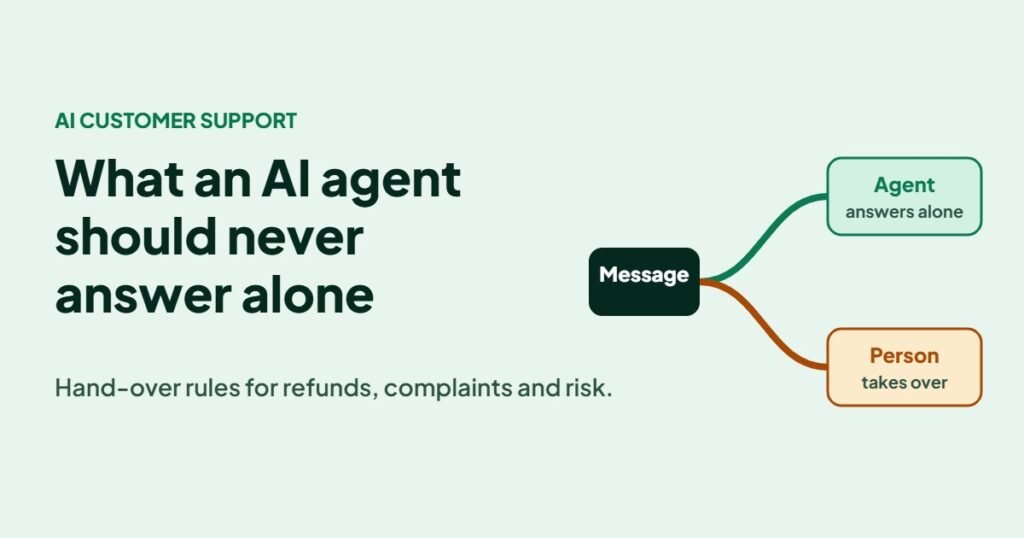
An AI support agent answers well when the answer exists in your content. It answers badly when the question needs judgement, authority or care. Hand-over rules decide which is which, and they are the most important setting you will configure.
AI answers can occasionally be incomplete or wrong, especially for questions your content does not cover. That is why our terms ask you to set hand-over rules for sensitive matters and not to rely on the agent alone for them.
The agent answers well when the answer is in your content. People handle judgement, authority and care.
Agent answers alone
- Opening hours
- Prices from your list
- Delivery times
- How to book
- Where an order is
- How a product works
Hand to a person
- Refunds outside your policy
- Upset customers
- Legal and compliance
- Medical or health
- Payment disputes, account security
- Custom quotes, high-value orders
- Safety issues
Questions that should go to a person
Route these to a person every time.
- Refund or exception requests outside your written policy. The agent can explain the policy, and a person decides whether to bend it.
- Complaints from an upset customer. Someone who is angry wants a person to take responsibility, and a polished automated reply makes it worse.
- Legal questions, contracts and compliance.
- Medical or health questions, including symptoms, doses and whether something is safe.
- Payment disputes, account security and anything involving someone’s money or identity.
- Custom quotes and large or high-value orders.
- Safety issues, such as a damaged product that could hurt someone.
Questions the agent can answer alone
Anything with a fixed, checkable answer: opening hours, prices from your list, delivery times, how to book, where to find an order, how a product works. If your website or help articles already state it, the agent can quote it.
Write fixed answers for what must not vary
For prices, hours, policy wording and contact details, store the exact text and mark it fixed. The agent then repeats your words and does not paraphrase them. It is also instructed not to invent prices, policies or contact details, so a question with no answer in your content should end in a hand-over, not a guess.
How to write one hand-over rule
Each rule has four parts: what triggers it, what the customer sees, who is alerted and how quickly someone should reply. Here is an example for refunds.
- Trigger: the customer asks for a refund and the order is older than the refund window in your policy.
- Customer message: “I’ve passed your request to our team. They will reply here within one working day.”
- Alert: the support lead, by email and WhatsApp.
- Reply target: within one working day, as the message promises.
What the customer sees during a hand-over
Tell the customer that a person will take over and when to expect the reply. Never leave them in a loop of automated answers. The agent should pass the whole conversation to your team, so the person who picks it up does not ask the customer to repeat what they already wrote.
Outside working hours, the message should say when someone is next online. A reply promising “within one working day” on a Friday evening means Monday, and the message should say so.
What it looks like by industry
A store hands over refund exceptions and damaged-goods reports (see e-commerce). A clinic hands over any message about symptoms or medicines and leaves booking and opening hours to the agent (healthcare operations). An estate agent hands over price negotiation and offers while the agent shares listings and viewing times (real estate). A financial service hands over anything about a specific transaction or account (fintech).
Test the rules before launch
Send 20 test messages that include awkward ones: an angry complaint, a refund after the window, a question with no answer in your content, a message in a different language. Check that each one ends where you intended. After launch, read the hand-over log weekly for the first month and add a rule whenever something slipped through.
The same checks form part of our two-week pilot, and the terms of use set out what the agent can and cannot be relied on for.
